WE DO SAME DAY CROWN




Don’t guess your recovery timeline. Learn how long pain meds are safe after tooth extraction in Carrollton, TX, and what signs to watch for.
Getting a wisdom tooth out feels like crossing a finish line until the numbing wears off. Then the real question kicks in: how long do you actually need painkillers, and when is it safe to stop?
It’s a completely valid thing to wonder. Pain management after an extraction isn’t just about comfort, it directly affects how well you heal. Take too little too soon, and you’re unnecessarily suffering. Taking them longer than needed risks other problems. Here’s a clear, practical breakdown of what to expect and what to do.
The First 24 to 72 Hours: When Pain Is at Its Peak
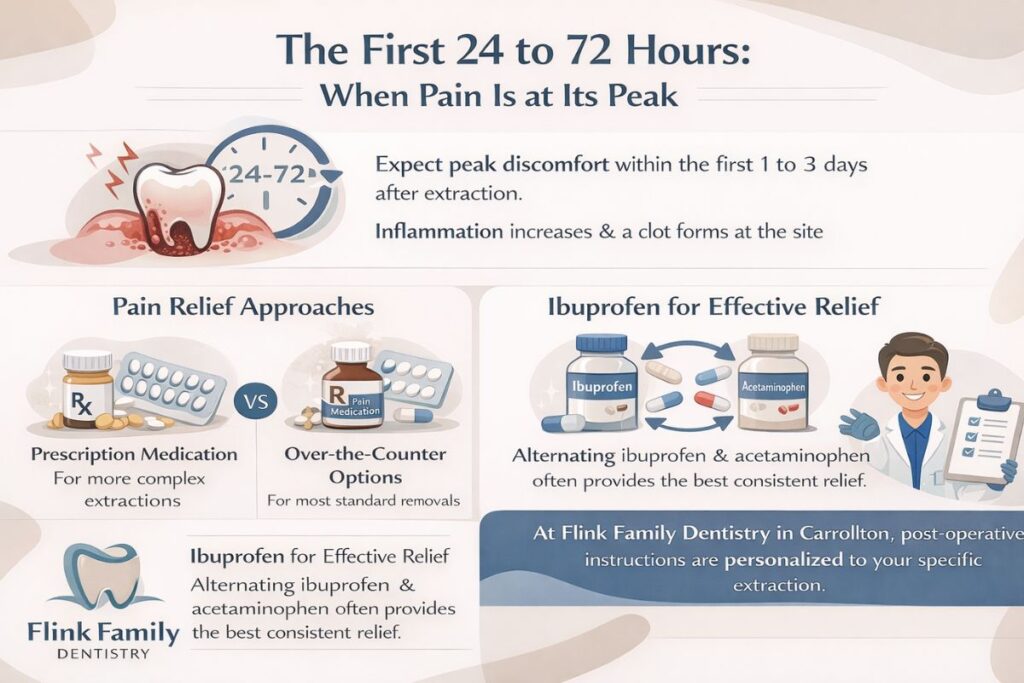
The most intense discomfort typically occurs within the first 1 to 3 days after the procedure. This is when your body is actively responding to the surgical site, inflammation peaks, the clot forms, and the surrounding tissue starts to reorganize. During this window, consistent pain management is genuinely important.
Your dentist will usually recommend one of two approaches:
- Prescription pain medication (like a short course of a mild opioid or a prescription-strength NSAID) for more complex extractions, impacted wisdom teeth, for instance, that required cutting through bone or tissue
- Over-the-counter options like ibuprofen (Advil, Motrin) or acetaminophen (Tylenol), which work well for most standard removals
Ibuprofen tends to be the more effective choice for tooth extraction pain because it addresses both the pain and the underlying inflammation simultaneously. A common approach dentists recommend is alternating ibuprofen and acetaminophen every few hours, which provides more consistent relief than relying on either one alone though always follow your provider’s specific instructions.
For patients undergoing tooth extraction in Carrollton at Flink Family Dentistry, post-operative instructions are personalized to the specifics of your extraction. Don’t assume your neighbor’s experience will mirror yours.
How Long Should You Actually Take Them?
For most people, painkiller use tapers off naturally between days three and five. Here’s a rough but realistic timeline:
- Days 1-3: Take pain medication consistently as directed, even if discomfort feels manageable. Staying ahead of inflammation is easier than chasing it.
- Days 3-5: Pain should begin to noticeably improve. Many people shift to taking medication only when discomfort flares, rather than on a fixed schedule.
- Day 5 and beyond: Most patients no longer need medication. Mild soreness or sensitivity at this stage is normal and usually manageable.
Prescription medications, like any opioid-based options, should only be taken for as long as your dentist prescribes. These are usually a three to five-day supply for a reason. If your prescription runs out and you still feel you need something strong, call your dentist rather than seeking additional medication elsewhere.
Warning Signs That Something Isn’t Right
Pain that worsens after day 3 rather than improving is a serious health concern. It may indicate dry socket, a condition where the blood clot that protects the extraction site is dislodged or dissolves prematurely. Dry socket causes a sharp, radiating ache that no amount of ibuprofen fully quiets.
Other signs worth calling your dentist about:
- Increasing swelling after the first 48 hours
- Fever above 101°F
- Numbness that doesn’t resolve
- Pus or unusual discharge from the extraction site
- Difficulty swallowing or opening your mouth
These symptoms don’t mean something has gone terribly wrong but they do mean you need professional guidance, not more painkillers.
Know Your Resources for Recovery
Recovery doesn’t have to be a guessing game. If you’re in the Carrollton area, you have access to a dental team that will walk you through the specifics of your recovery before you even leave the chair.
At Flink Family Dentistry, the approach to tooth extraction in Carrollton is built around making sure you know exactly what to expect including a clear post-op plan that covers pain management, diet, and what to watch for during healing.
Tips to Support a Smooth Recovery
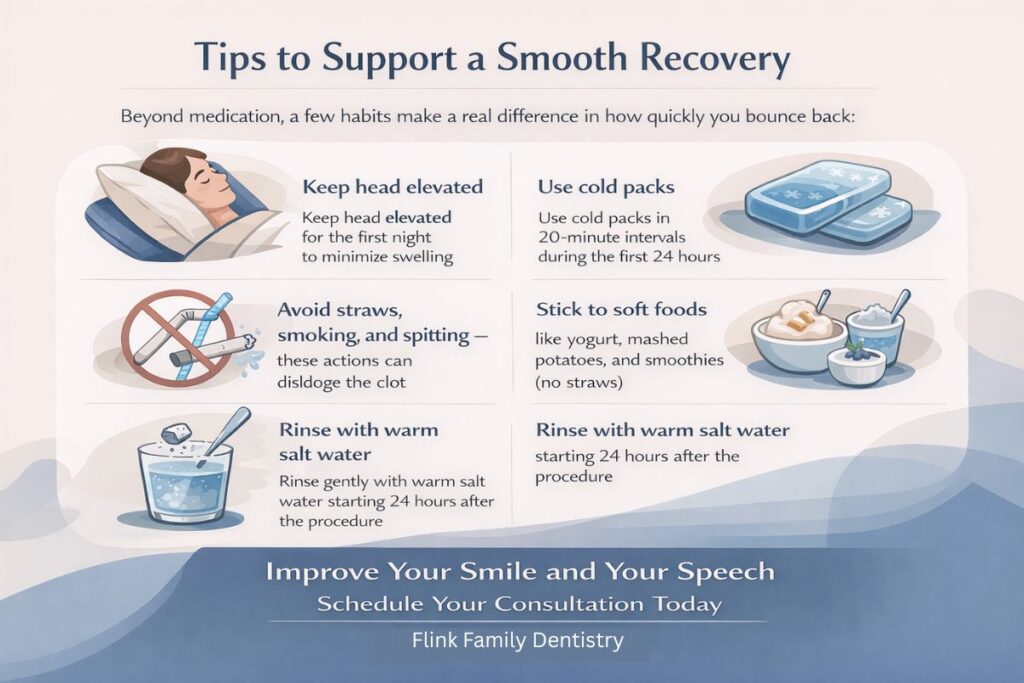
Beyond medication, a few habits make a real difference in how quickly you bounce back:
- Keep your head elevated for the first night to minimize swelling
- Use cold packs in 20-minute intervals during the first 24 hours
- Avoid straws, smoking, and spitting, these actions can dislodge the clot
- Stick to soft foods like yogurt, mashed potatoes, and smoothies (no straws)
- Rinse gently with warm salt water starting 24 hours after the procedure
Good aftercare works in tandem with pain medication not instead of it.
If you’re preparing for a wisdom tooth removal or are still in recovery and have questions, don’t let the uncertainty linger. Book an appointment with Flink Family Dentistry in Carrollton today and get the clear, personalized guidance your recovery deserves.
People Also Ask
Q: Can I take ibuprofen and acetaminophen at the same time after a tooth extraction?
Yes, this is actually a commonly recommended strategy by dental providers. Since ibuprofen and acetaminophen work through different mechanisms, they can be taken together or alternated safely for most adults. However, always follow the dosage guidelines on each label and confirm this approach with your dentist based on your health history.
Q: Is it normal to still feel some pain a week after wisdom tooth removal?
Mild residual soreness or tenderness at the extraction site for up to a week — or slightly beyond — can be within the range of normal healing, especially for impacted teeth that required more involved removal. However, sharp or worsening pain after day five warrants a call to your dentist to rule out dry socket or infection.
Q: Can I drive after taking prescription pain medication post-extraction?
No. Prescription pain medications especially those with opioid components — impair reaction time and judgment. You should not drive or operate machinery while taking them. Plan to have someone with you for the first day or two if you’ve been given a prescription beyond over-the-counter options.
Q: Does the type of extraction affect how much pain to expect?
Yes, significantly. A simple extraction, in which the tooth has fully erupted and is removed with minimal intervention, results in less postoperative discomfort than a surgical extraction, in which the tooth is impacted, partially erupted, or needs to be sectioned. Your dentist should give you a realistic expectation based on your specific case before the procedure.
Q: What soft foods are actually filling enough during recovery?
Good question, hunger is real during recovery. Some extraction-friendly options include scrambled eggs, cottage cheese, mashed sweet potatoes, well-cooked oatmeal, protein shakes (no straw), blended soups, and soft fish like tilapia. Avoid anything crunchy, spicy, or that leaves small particles that could irritate the site.